 Elmer
Elmer
Which electric car is right for you?
Almost every new electric car can handle everyday driving. What sets them apart is size, how far they go on a charge, and how fast they charge on a trip. And then the price, both when you buy and every year after.
Start with the size
Choose the size you need day to day, not the one you need once a year. For the summer holiday you can hire a trailer or a roof box. If the car needs to tow a caravan, check the towing capacity: many smaller EVs can only tow 750 kg, and some cannot tow at all.
Range
The WLTP figure in the brochure rarely holds up. Expect 10–20% less in normal driving, and more in winter and on the motorway. On a long trip you typically drive between 80% and 10%, so you only use 70% of the battery between two charging stops. If you rarely drive more than 300 km in a day, a mid-sized battery is enough.
Charging time beats range
On a long trip, it is the charging time you notice. Check how long the car takes from 10 to 80% on a rapid charger. Good cars do it in 20–25 minutes, slow ones in 40–50. Cars with 800-volt systems usually charge fastest. Peak power in kW says less, because many cars only hold it briefly.
What does the car cost per year?
The biggest cost is depreciation, not electricity. A car that costs 100,000 DKK more typically loses 10,000–15,000 DKK more in value per year. Electricity for 15,000 km costs around 5,000 DKK per year if you charge mostly at home at night. That is calculated with the electricity tax from 2028, when it goes up again. The annual vehicle tax (ejerafgift) for an EV is the lowest rate. Servicing is a little cheaper than for a petrol car, while insurance is usually a little more expensive.
Electric or petrol?
Electric cars usually lose a bit more value than petrol cars at the same price. On the other hand, electricity is much cheaper than fuel: petrol costs 18.09 DKK per litre and diesel 18.89 DKK (13 October 2026), while electricity at home at night costs about 1.28 DKK/kWh. At 15,000 km per year you typically save 6,000–10,000 DKK on electricity instead of petrol if you charge at home. Against a hybrid, the difference is smallest. Electric cars have also paid less registration tax: in 2026, EVs priced under about 420,000 DKK pay none at all. If you only charge away from home, the difference shrinks, but the EV is usually still cheapest.
 Buy, private lease or flex lease an EV in Denmark?
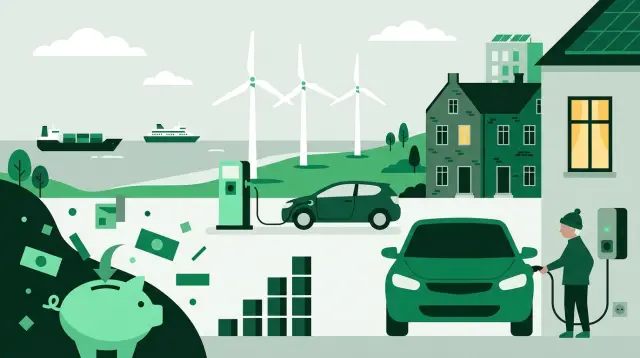 What does an electric car cost per year in Denmark?
 Your first electric car in Denmark
 Why does EV charging slow down? The charging curve